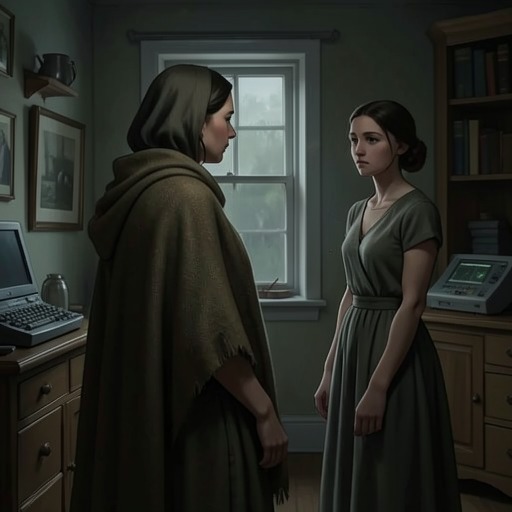
María Josefa’s perceived madness
The House of Bernarda AlbaMaría Josefa’s perceived madness is both a condition her family uses to confine her and a dramatic form through which the play voices what the household suppresses: longing for children, open homes, and a life beyond its walls. Her words move between apparent disorientation and sharp recognition of the daughters’ shared desire for Pepe el Romano, making her a disturbing counterpoint to Bernarda Alba’s rule of mourning and silence.
Confinement and the Household
María Josefa appears in a household already organized by enclosure. The opening stage directions place the action in the intensely white interior of Bernarda Alba’s house, with thick walls, arched doors, and a great silence hanging over the scene. Later, María Josefa enters while Martirio stands watchfully at the centre of the stage; when she asks to be let out, Martirio questions where she is going. The exchange makes confinement a practical reality, not merely a metaphor: her family monitors her movements and treats her wishes to leave as a problem to contain.
Her family’s response also shapes how her speech is heard. Martirio repeatedly tells her to lower her voice or be quiet, echoing the household’s broader enforcement of obedience and secrecy. María Josefa’s perceived madness may mark her as an unreliable or disruptive speaker within the family, but the play gives her words substantial insight into the desires and pressures that its more controlled characters cannot openly express.
Children, Waves, and Mourning
In one of her most sustained speeches, María Josefa rejects the assumption that her age and white hair make motherhood impossible. She imagines having children, then children having children, until generations with snow-white hair become like successive waves and finally foam. The image turns private longing into an expanding vision of continuity and shared life. Against it she places the household’s mourning clothes: where she imagines waves and foam, she says, there is only mourning.
Her recollection of exchanging chocolate with a neighbour after each woman had a child gives that vision a social shape. The remembered reciprocity contrasts with the present household, where the neighbours will not come and she fears leaving alone. She asks for help getting beyond the fields and imagines open houses, women beside their children, and men sitting outside. Her desired freedom is thus more than escape from a locked room: it is a picture of ordinary communal life, made impossible by the household’s isolation.
A Disruptive Voice in the Plot
María Josefa’s speech brings together the family’s sexual rivalries and its enforced silence. She names Pepe el Romano as a giant whom the daughters all want, then imagines him devouring them. The image transforms the household’s concealed competition into a warning about their exposed position, even as her abrupt correction—from grains of wheat to frogs without tongues—makes the speech seem disjointed. The words are not a straightforward account of events; their force lies in joining the daughters’ desire to the silencing that governs them.
Her presence also belongs to a play grounded in the social world of its time. Lorca described the work as a photographic documentary of village life and framed it as a drama of women in Spanish villages. Within that realist setting, María Josefa’s unruly images widen the play’s account of domestic restriction: she speaks of reproduction, neighbours, and open homes in a house governed by mourning, surveillance, and commands for quiet.
Inheritance and Significance
The play’s commentary connects María Josefa’s condition to the possibility of inheritance. An explanatory note observes that physical and personal traits recur in Lorca’s work and that the manuscript’s reading identifies María Josefa as Bernarda’s mother. It suggests that if Bernarda inherited her mother’s physical strength, the daughters might in turn inherit aspects of their mother’s state. This is presented as an implication rather than a diagnosis or a certain prediction, but it gives the family’s fear of María Josefa a generational dimension: what the household confines may not be contained by confinement alone.
María Josefa’s perceived madness therefore has a double dramatic effect. It isolates her from ordinary authority while allowing her to articulate the family’s suppressed future—children and continuity—in contrast to a present defined by mourning and silence. Her recurring wish to leave the fields for open houses makes freedom imaginable, but not attainable within the household’s rules.